
Boostcamp’s pitch is seductive: a massive program library — marketing often cites 11,000+ programs — so you never run out of templates. Optimized Strength’s pitch is the opposite shape: fewer shelves, deeper coaching. A conversational AI coach plus a gym SaaS lane Boostcamp is not built to own.
If you are a program collector, Boostcamp feels like a candy aisle. If you are a lifter who keeps restarting week one of famous templates, library size is not your bottleneck. Execution is.
This showdown is breadth versus depth. Spoiler for 2026: you probably do not need eleven thousand programs. You need the right stimulus, honest feedback, and software that still works when your schedule and your gym are imperfect.
Boostcamp’s library advantage
Discovery is Boostcamp’s strength. Popular programs, creator templates, structured blocks — it is easy to find something that looks legit and hit start. For lifters who enjoy browsing methodologies (PPL, strength cycles, hypertrophy blocks), that catalog is genuinely fun and occasionally useful.
A big library also helps beginners who do not know what “good” looks like yet. Seeing named programs with social proof reduces anxiety. That onboarding effect is real and should be acknowledged.
The tax is shallow AI and shallow follow-through. More content is not the same as coaching. Recommendations can feel like “try another program” when the actual need is “adjust this week’s volume because life punched you in the face.”
Optimized Strength’s coaching + gym wedge
Optimized Strength invests in conversational coaching with Gemini — ask why a program is stalling, how to swap equipment, when to cut volume, how to keep progressive overload without ego loading. Community keeps accountability without turning every session into content farming.
Then there is the gym SaaS angle. Boostcamp serves individual program shoppers. Optimized Strength can sit with gym owners who need attendance discipline, clearer billing, and a member app that matches the training product. Different customer. Different moat.
Curated programs still matter. The point is not anti-library snobbery. The point is that a smaller set of well-supported plans plus a coach you can talk to beats an endless aisle you never finish.
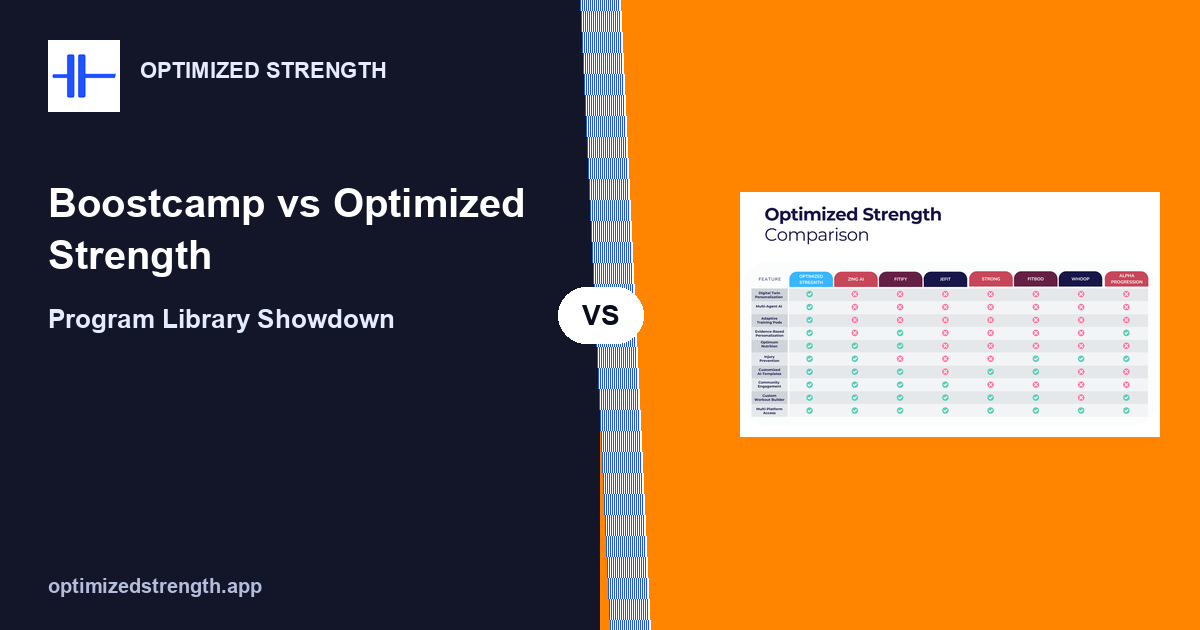
Comparison table
How to choose without kidding yourself
Choose Boostcamp if your bottleneck is “I want to browse famous programs and try something new.” Choose Optimized Strength if your bottleneck is “I want a coach I can talk to — and maybe my gym wants software that does not leak fees.”
Library size is a vanity metric past a point. Consistency is the scarce resource. Optimized Strength optimizes for execution: conversation, progression, and the gym context around the lifter.
If you love browsing programs, keep browsing — curiosity is useful. Just set a rule: do not switch templates until you finish the current block or you have a clear reason the block failed. Optimized Strength makes that rule easier because the AI coach can help you modify the plan you already chose instead of seducing you into another download. Depth compounds. Endless novelty usually does not. Treat the library as a starting point, not a personality.
Finish the block. Then decide.
CTA: Pick one program you keep restarting. Rebuild or load the structure in Optimized Strength, then ask the AI coach what to change this week. Compare that to downloading program number 11,001 and hoping this time is different.