
Strong built a quiet religion around one idea: logging should be fast. Open the app, hit the lifts, leave. No feed addiction, no twelve-step onboarding, no lecture between sets. For years that minimalism made Strong the default recommendation for lifters who hate tools that try to become social networks.
Optimized Strength agrees with the first half of that gospel. If logging is slow, nobody logs. Where the products diverge is the second question: what happens after the set is saved? Do you get coaching? Community? A path from “I wrote numbers” to “I got stronger on purpose”?
This face-off is minimalist logger versus logger-plus. Neither side is fake. They are solving different jobs — and you should pick based on the job you actually have.
Strong’s edge: speed and focus
Strong’s UI is battle-tested. Rest timers, repeat-last-workout flows, and a calm layout keep friction low. There is little AI theater. That is a feature if you already have a program from a coach, a book, or your own spreadsheet brain.
Strong also attracts people who are allergic to engagement metrics. Not every lifter wants a feed. Some want a stopwatch with a good memory. Respect that preference — it is why Strong still earns loyalty in 2026.
The ceiling appears when you stall. Strong shows history beautifully. It will not coach you through a plateau, hold a conversation about RPE drift, or give your gym a modern member experience. Minimalism becomes incompleteness when guidance is what you are missing.
What Optimized Strength layers on
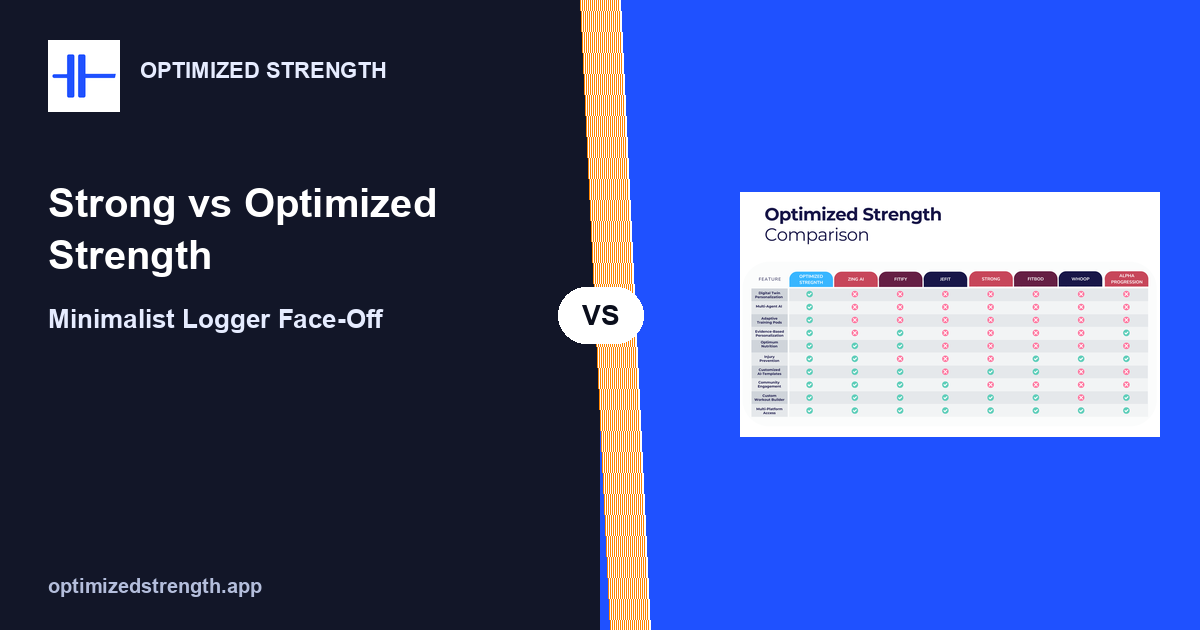
Optimized Strength keeps progressive logging — sets, reps, load, RPE — then adds a conversational Gemini coach, programs, and community. The bet is simple: most lifters do not fail because they cannot find a notes field. They fail because nobody helps them interpret the notes when life gets noisy.
For gym businesses the gap widens. Strong is not trying to be gym management software. Optimized Strength connects member training to owner-side needs so the same brand that logs your bench can support attendance and dues workflows on the floor. That is optional for a solo lifter and decisive for an owner.
Speed still matters. Coaching features are worthless if the logger feels heavy. Optimized Strength’s design goal is to stay fast at the rack while unlocking depth when you have thirty seconds to ask a better question.
Feature table
Who wins the face-off
Pick Strong if you want a quiet, fast logger and you already know exactly what to do every session. Pick Optimized Strength if you want that logbook to become a coaching relationship — with AI you can question, community when you want it, and gym tooling if you run a floor.
Minimalism is not the enemy. Incomplete tools are. Strong proved logging can be calm. Optimized Strength is proving calm logging can still be smart without turning into circus software.
A fair caveat for Strong fans: if you already work with a great human coach and only need a clean log, adding AI can feel like noise. Optimized Strength is not trying to replace every coach. It is for the huge middle: self-coached lifters, busy professionals, and gyms that cannot put a trainer beside every member. In that middle, a fast logger plus a coach you can question is not bloat — it is the missing layer between notes and progress.
Try this: Log your next session in Optimized Strength and ask the AI coach one question Strong cannot answer — “Based on this week, should I push or deload?” That single contrast is the review.